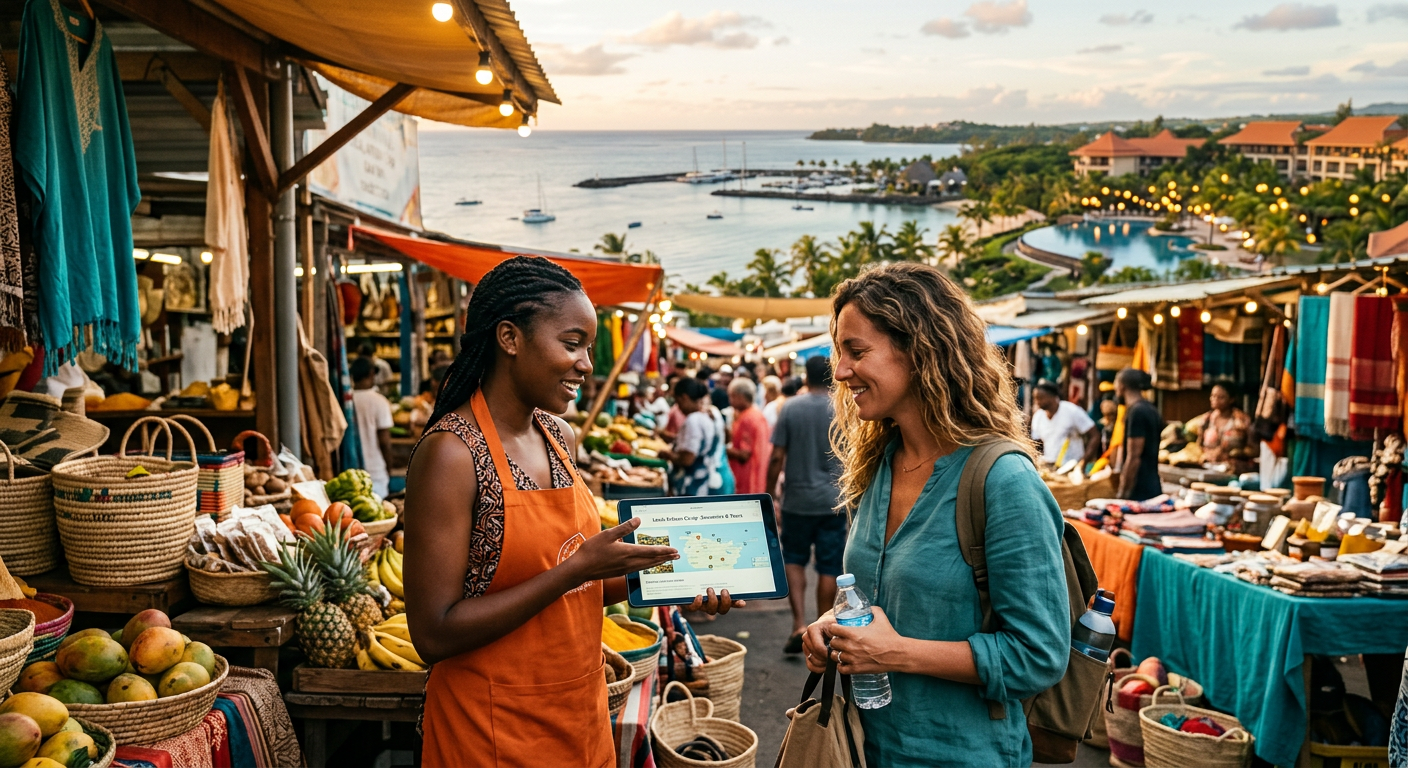
Growth in tourism shouldn't just belong to the giants. Discover how modern systems are finally letting local entrepreneurs claim their seat at the table.
Most people think of tourism as a waterfall. A massive resort moves into a coastal town, floods the area with capital, and everyone downstream is supposed to wait patiently for the overflow. We’ve been told this for decades. It’s the 'anchor tenant' theory of economic development. But if you look at the actual data, that waterfall often feels more like a leaky faucet for the people living three blocks away from the lobby.
Here’s the thing: The old model of top-down tourism is broken. It’s inefficient. It’s brittle. And frankly, it’s boring for the modern traveler who wants something real. We’ve entered an era where technology doesn't have to be a barrier that keeps locals out; it can be the bridge that lets them in. We don't need more 'trickle-down' economics. We need a web of connected, local experts who can finally talk to the same customers the big guys do.
The Myth of the 'All-Inclusive' Monopoly
We’ve observed a frustrating pattern in our work with growing destinations. A major resort opens, and suddenly, the local tour guide, the family-run cafe, and the artisanal craft shop find themselves invisible. Why? Because the resort owns the data, the booking platform, and the physical gate. They aren't necessarily trying to be villains—they’re just running a closed system. It’s easier to sell a pre-packaged bus tour than to coordinate with twelve independent operators.
But here is the contrarian take: The big resorts actually need the locals more than they realize.
The 2025 Global Travel Trends report found that 73% of travelers now prioritize 'authentic local experiences' over standard resort amenities. When a resort walls itself off, it actually lowers the value of its own product. A gold-plated cage is still a cage. By using technology to open up their supply chains, these giants can offer better variety while local MSMEs (Micro, Small, and Medium Enterprises) get a fair shot at the revenue. It’s not about charity; it’s about better business.
Digital Marketplaces: Leveling the Tech Playing Field
In the past, if a local boat captain wanted to reach a guest at a five-star hotel, he had to stand on the beach with a sign. That doesn't work anymore. Today, the battle for attention happens on a screen months before the flight even takes off.
Modern digital marketplaces are changing the math. These aren't just booking sites; they are ecosystems. Think of them as the 'connective tissue' between a massive hotel's concierge desk and a solo entrepreneur's calendar. When these systems are designed with a human-centered approach, they remove the friction of insurance, payments, and scheduling that usually scares big corporations away from small vendors.
- Direct-to-Guest APIs: Allowing local tours to appear in the resort's own mobile app.
- Unified Payment Gateways: Ensuring the local vendor gets paid instantly, not in 90 days.
- Verified Trust Signals: Using blockchain or peer-reviews to give small players instant credibility.
"The goal isn't to make the local entrepreneur look like a corporation. It's to give them the professional tools of a corporation so they can stay local."
The Data Gap: Why Sharing is Winning
Data is the new currency, but right now, the exchange rate is terrible for small businesses. Large hotel chains know exactly when a guest is landing, what they like to eat, and how much they’re willing to spend. The local restaurant owner? They’re just guessing.
But what if that changed? We are seeing a rise in 'Destination Data Trusts.' These are initiatives where local governments and private sectors pool anonymous traveler data to help everyone plan better. If a local bakery knows that 500 gluten-free travelers are arriving on Tuesday, they can adjust their inventory. That’s not just 'modern'—it’s practical. It prevents waste. It builds a sustainable local economy.
The Impact of Data Symmetry
Research from the 2024 Tourism Economic Forum showed that destinations using shared data platforms saw a 22% increase in spending at local, non-resort businesses compared to those with closed data silos.
Modern Systems vs. 'The Grind'
Let's be honest. Running a small business is hard enough without having to become a software engineer on the side. We talk to entrepreneurs every day who feel buried by their own tools. They have one app for bookings, another for Instagram, a notebook for taxes, and a prayer for the Wi-Fi.
Connected systems shouldn't feel like another chore. They should feel like a partner. For a local craft weaver in a rural village, a simplified inventory system that syncs with a regional marketplace isn't a 'hack.' It’s a lifeline. It means she spends less time wrestling with a spreadsheet and more time at her loom. That is what we mean by human-centered technology.
| Feature | The Old Way (Top-Down) | The New Way (Decentralized) |
|---|---|---|
| Revenue Flow | Stays within the resort walls | Circulates through the community |
| Guest Experience | Standardized and predictable | Unique and personal |
| Technology | Proprietary and closed | Open and integrated |
| Risk | High (if the resort fails, all fail) | Low (diversified local economy) |
Building a Sustainable Future Together
This shift isn't going to happen overnight. It requires intentional design. It requires resorts to realize that a thriving local community is their best marketing asset. And it requires local entrepreneurs to move away from fragmented tools toward reliable, streamlined systems that actually work.
We’ve seen what happens when this works. A boutique hotel in the Mediterranean started using a shared booking platform for local fishermen to offer sunset trips. Within one season, those fishermen saw a 40% increase in income, and the hotel’s guest satisfaction scores hit an all-time high. No one had to 'disrupt' anything. They just had to connect.
The technology is already here. The question is: are we going to use it to build higher walls, or are we going to build better paths?
Ready to simplify your systems?
Growing your business shouldn't feel like a constant battle with your own tools. At CrossMedia, we help you find clarity in the chaos. Whether you're a local operator or a growing brand, we design the workflows that let you focus on what you do best.