Stop buying shiny apps your guests will never download. Here is the real business case for upgrading your property's technology—and how to actually pay for it.
Most hotel tech advice is garbage. I don't say that to be provocative—though it certainly sparks a reaction—but because our team regularly watches smart property managers sink thousands into shiny guest-facing apps that nobody actually downloads. Here is the thing: what worked in Silicon Valley won't necessarily work in St. James. The game is different here. And nobody sent the memo.
Seriously.
If you operate a hotel, tour company, or attraction in Barbados, you are selling an experience rooted in warmth, connection, and human hospitality. So when consultants tell you to replace your front desk with a self-serve kiosk to save money, they are fundamentally misunderstanding your product. Your guests fly thousands of miles for Bajan hospitality. Not for a touchscreen.
The Contrarian Truth About Hospitality Tech
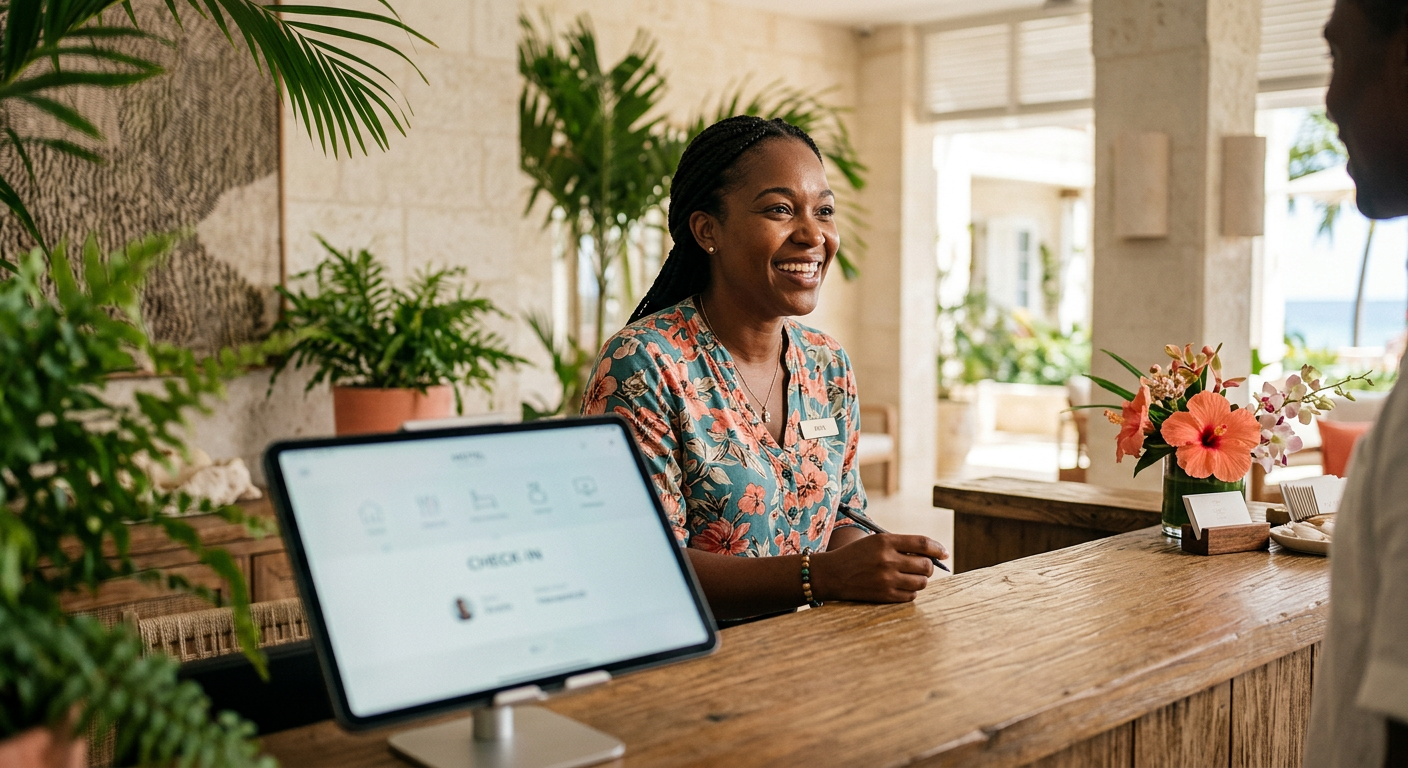
Everyone assumes modernizing means becoming more digital and less human. We believe the exact opposite. The best technology in the tourism sector shouldn't be seen by the guest at all.
It should be invisible.
Consider Marcus, a composite of several boutique hotel owners we have worked with recently. Marcus manages a beautiful 40-room property near Holetown. A few years ago, his staff spent three hours every afternoon manually reconciling bookings from Expedia, Booking.com, and direct emails. The front desk was a chaotic mess of sticky notes. When guests arrived, the staff were too busy staring at screens to actually look up and smile. They were wrestling with their systems. Constantly.
We helped his team implement a cloud-based property management system (PMS) that talked directly to his channel manager. The result? The sticky notes vanished. The frantic typing stopped. And suddenly, his staff had the time to ask guests about their flight, offer a cold towel, and actually connect. Bookings went up. Stress went down.
The 2026 Shift: High-Touch, Tech-Assisted
Industry data from early 2026 shows a massive pivot. After the post-2020 rush toward 'contactless everything,' guests are heavily penalizing brands that lack human interaction. The new standard is 'High-Touch, Tech-Assisted'—where backend software handles the heavy lifting so humans can handle the hospitality.
Quantifying the ROI: Show Me the Money
Upgrading your systems requires capital. And if you are pitching this to a board, a bank, or just your own sensible financial conscience, you need hard numbers. You need a business case. Let's break down exactly where the return on investment actually comes from.
1. Revenue: The Math of Dynamic Pricing
If you are setting your rates manually twice a year, you are leaving money on the table. Full stop. Modern revenue management systems track local demand, competitor pricing, and historical booking curves to adjust your rates automatically. It is not magic. It is just math.
In our observation across Caribbean properties, moving from static seasons to dynamic pricing yields an average Revenue Per Available Room (RevPAR) increase of 12% to 18% within the first twelve months. For a property doing $2 million annually, that is a $240,000 bump. The software pays for itself by February.
2. Operational Costs: Stopping the Bleed
Electricity in Barbados is not cheap. You know this. Yet, we walk past dozens of empty hotel rooms every week with the air conditioning blasting at 18 degrees Celsius. Why? Because housekeeping forgot to turn it off, or the guest left it running while they went to Oistins.
Smart energy management systems—thermostats linked to your booking system that automatically dial back the cooling when a room is unrented or unoccupied—are the most reliable cost-savers in the industry. Recent sustainability reports indicate these systems reduce in-room energy consumption by 22% to 28%. When you calculate your monthly utility bill, that percentage represents pure, bottom-line profit.
3. Staff Retention: The Hidden Metric
Here is what most people miss. Bad technology makes your staff hate their jobs.
When night auditors have to stay until 3 AM because the payment gateway will not sync with the ledger, they quit. Replacing a trained front-desk supervisor costs roughly 30% of their annual salary in recruiting, training, and lost productivity. Practical, reliable tools keep your best people from leaving for the resort down the road.
| Technology Investment | Primary Benefit | Average Payback Period |
|---|---|---|
| Cloud-Based PMS | Eliminates double-bookings & manual entry | 6 - 9 Months |
| Smart Room Thermostats | Reduces utility costs by up to 28% | 12 - 18 Months |
| Dynamic Pricing Engine | Increases RevPAR by 12-18% | 3 - 5 Months |
| Direct Booking Engine | Saves 15-20% on OTA commissions | Immediate |
Addressing the Elephant: "We Can't Afford It"
This is the most common objection we hear. And it is entirely valid. Cash flow is tight, and the off-season can be brutal. But let's reframe the conversation.
You are already paying for these upgrades. You are just paying for them in OTA commissions, wasted electricity, lost direct bookings, and staff turnover. You are funding the inefficiency. Wouldn't you rather fund a solution?
Another common fear is the learning curve. "My staff won't learn a new system." If the system requires a PhD to operate, that is a bad system. The goal is clarity. We focus on human-centered design because software should adapt to how your team works, not the other way around. If an upgrade causes more stress than it solves, it failed.
How to Actually Fund the Work
You do not have to drain your operating account to modernize. The landscape for funding tech and sustainability upgrades in the Caribbean has shifted dramatically in the last two years.
- Green Energy Loans: Local banks and credit unions in Barbados now offer highly favorable terms for upgrades that reduce your carbon footprint. Smart thermostats and automated energy systems qualify.
- International Grants: Agencies like the IDB (Inter-American Development Bank) frequently release grant funding for tourism digitization. Keep a close eye on regional tourism associations for application windows.
- Software as a Service (SaaS) Models: You no longer need to buy massive servers. Most modern systems charge a manageable monthly fee based on your room count. It becomes an operating expense, not a massive capital expenditure.
The Cost of Standing Still
The tourism market in Barbados is competitive. Travelers are comparing your direct booking experience with properties globally. If your website takes ten seconds to load, or if they have to wait 24 hours for an email reply to confirm a room, they will simply book elsewhere. They will go to the property that made it easy.
Growing a business shouldn't feel like wrestling technology. It should feel like building a partnership with your tools. You want systems that work quietly in the background, supporting your team, simplifying your day, and protecting your bottom line.
Modernizing is not about replacing the Bajan smile. It is about giving your team the time and energy to share it.