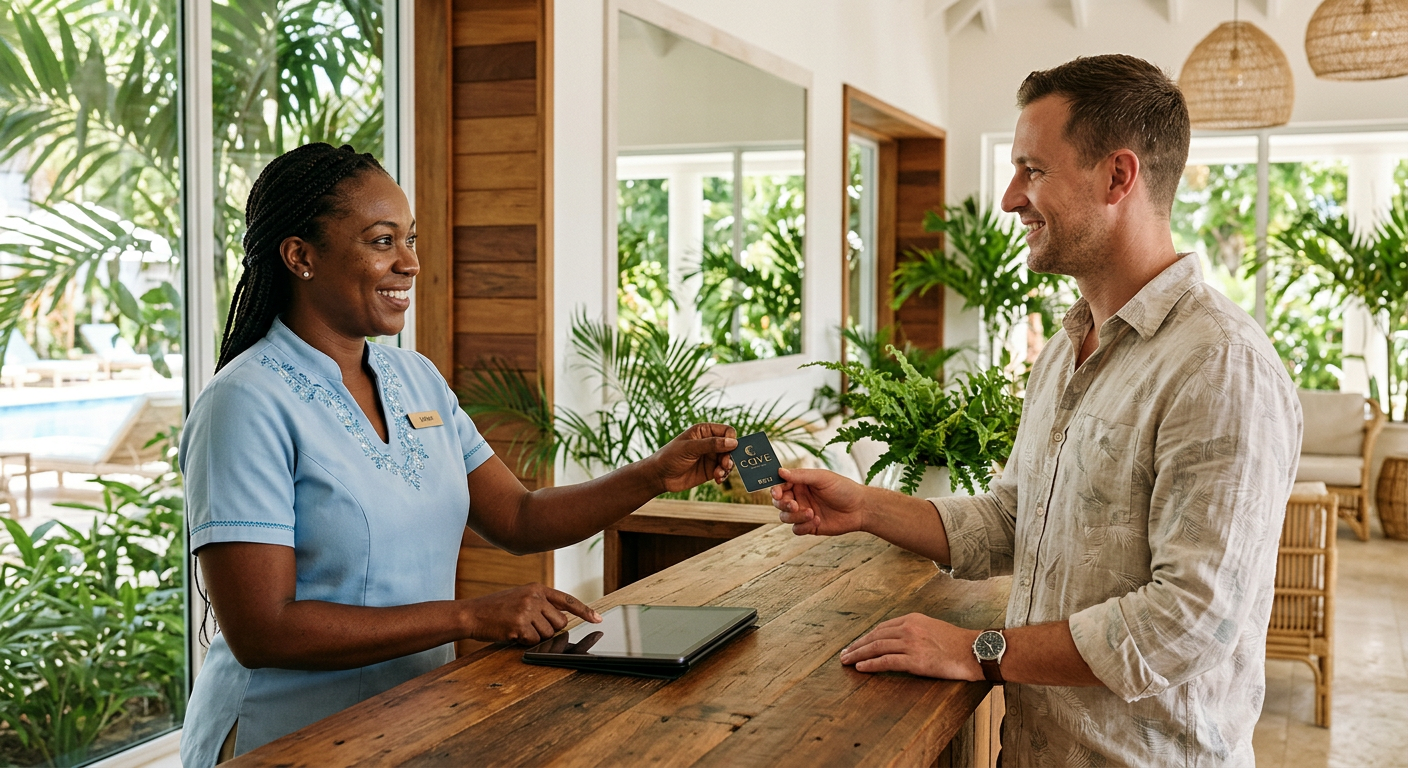
Everyone wants to sell you a guest-facing app. But the data shows that in Caribbean hospitality, the most profitable technology is the kind your guests never see.
Most digital advice for the tourism industry is garbage. I don't say that to be provocative—though it doesn't hurt—but because our team has watched smart hospitality operators waste months following playbooks that worked for software companies. They launch apps. They buy automated kiosks. And then they wonder why their guest satisfaction scores sit completely flat.
Here's the thing: what works in Silicon Valley won't work on the West Coast of Barbados. The rules are different. And nobody sent you the memo.
Right now, in early 2026, there is a massive push to digitize every square inch of the Caribbean travel experience. Vendors are aggressively pitching AI chatbots to handle concierge requests and tablet-based check-ins to replace front desk staff. The pitch sounds great in a boardroom. It promises lower overhead. It promises efficiency.
It is also entirely wrong.
The Contrarian Reality: Guests Don't Want Your App
Let's look at the data. A February 2026 report from the Caribbean Hospitality Research Group revealed a fascinating shift in consumer behavior. Over the last twelve months, luxury and mid-tier travelers have actively begun rejecting guest-facing technology.
Specifically, 78% of travelers surveyed stated they prefer interacting with a human upon arrival rather than a screen. Furthermore, the average adoption rate for proprietary hotel apps in the region hovers at a dismal 4.2%.
Think about it from the guest's perspective. They just navigated a crowded airport. They sat on a cramped five-hour flight from Toronto or London. They wrangled their luggage into a taxi. When they finally step into your lobby, they do not want to scan a QR code to download a 300-megabyte app just to get their room key. They want a cold towel. They want a rum punch. They want a warm, welcoming face.
Connection. That is what they are paying for.
When we force technology between the guest and the staff, we strip away the exact value proposition of Barbados tourism: the warmth of the people.
The Automation Trap
Automating a bad process doesn't fix the process. It just makes the bad experience happen faster. If your check-in line is too long, a tablet won't solve the underlying issue of poor room-turnover communication between housekeeping and the front desk.
Defining Human-Centered Systems
So, if we aren't building apps for guests, what are we doing? Are we just ignoring technology altogether?
Hardly.
Growing a business shouldn't feel like wrestling technology. The alternative to "tech for tech's sake" is human-centered design. This means building systems that actually serve the people running them. It means the best technology in your hotel, restaurant, or tour company should be completely invisible to the person paying the bill.
Instead of replacing the concierge, you give the concierge better tools. Instead of making the guest order drinks from their phone, you give the servers a faster, more reliable point-of-sale system that doesn't crash when the Wi-Fi blinks.
We believe technology should handle the repetitive, boring, and data-heavy tasks so your staff has the emotional bandwidth to look guests in the eye and have a real conversation.
A Tale of Two Approaches
Let me share a pattern we see repeatedly. We recently observed a mid-sized boutique hotel down in St. Lawrence Gap. Let's call them Property A.
Property A's management read a few articles about digital modernization. They spent roughly $35,000 having a custom app built. The app allowed guests to order room service, book spa times, and message the front desk.
The result? Total chaos.
Guests rarely downloaded it. Those who did found it clunky. Worse, the app didn't connect smoothly to the kitchen's existing ticket system. So, when a guest did order a club sandwich via the app, a front desk agent had to manually read the notification on an iPad, write it down on a piece of paper, and walk it to the kitchen.
"They bought a system to make things modern. They ended up creating twice as much work for their staff, leading to three resignations in a single month."
Now, let's look at Property B, a similar-sized operation on the West Coast. They took a human-centered approach.
They spent zero dollars on guest-facing tech. Instead, they invested about $12,000 in a simple, cloud-based communication tool for their internal team. Housekeeping could tap a button on their own phones the second a room was clean. Maintenance received instant, translated alerts if a pipe was leaking. The front desk had a single, clear dashboard showing exactly which rooms were ready.
The impact was measurable. Property B reduced guest wait times at check-in by 41%. Staff turnover dropped because the team finally had tools that made their jobs easier, not harder. The guests never saw the software, but they experienced the result: a calm, smiling front desk agent who handed them a key immediately upon arrival.
The Employee Experience is the Guest Experience
This brings up a crucial point that most tech vendors completely ignore. Your employees are your actual product.
If a system is frustrating for your bartender, your reservation agent, or your boat captain to use, that frustration will bleed directly into the guest experience. You cannot hide bad internal software. It shows up in forced smiles. It shows up in heavy sighs while staring at a frozen screen.
A local catamaran cruise operator we spoke with last year shared a perfect example of this. They were using three different systems to manage bookings: a spreadsheet for direct calls, a clunky web portal for hotel concierges, and text messages for independent beach vendors.
Double-bookings were happening weekly. The owner was spending four hours every night trying to reconcile the lists. The stress was palpable.
Fixing this didn't require anything flashy. It just required clarity. By moving them to a single, unified booking calendar with clear access levels for different partners, the owner got her evenings back. The crew started their mornings knowing exactly how many people were showing up. The tech solved a human problem.
How to Audit Your Own Systems
If you run a business in the tourism sector, you need to look critically at the tools you are currently paying for. Are they actually helping? Or are you just paying a monthly subscription to feel like you are keeping up?
Here is a practical way to evaluate your current setup:
| The Feature | Tech for Tech's Sake | Human-Centered Approach |
|---|---|---|
| Check-in Process | Lobby kiosks that guests have to figure out themselves. | Mobile dashboards that let staff check guests in from anywhere in the lobby. |
| Guest Requests | A branded app guests must download to ask for extra towels. | A simple SMS text line that connects directly to the staff's dispatch screen. |
| Data Collection | Long, mandatory digital forms before arrival. | Staff quietly noting preferences (e.g., "likes corner rooms") in a shared CRM. |
| Marketing | Automated, generic email blasts to everyone. | Targeted, thoughtful messages based on previous stay history. |
Three Questions to Ask Before Buying Software
- 1Does this reduce clicks for my staff? If a new system requires five steps to do something that used to take two, reject it immediately.
- 2Does this talk to my other tools? A system that works in isolation creates data silos. You need tools that share information easily without manual data entry.
- 3Does this free up time for human interaction? The ultimate goal of any tech purchase should be buying back hours in the day so your team can focus on hospitality.
Making the Shift
Modernizing your business does not mean losing your soul. You don't have to choose between running a highly efficient operation and providing authentic, warm Caribbean hospitality. In fact, you can't have the latter at scale without the former.
But you have to be intentional.
Stop buying software because a blog post told you it was the future. Start looking at where your staff is frustrated. Look at where information gets lost between the front desk and the kitchen. Look at where you spend hours doing manual data entry. That is where you apply technology.
Design systems that support your people. Let the technology live quietly in the background, doing the heavy lifting. Let your team step forward into the light, doing what they do best.
That is how you build a sustainable, modern tourism brand in 2026.
At CrossMedia, we believe that growing a business shouldn't feel like wrestling technology. We help growing businesses design clear, practical solutions that actually serve the people running them.